










The Spec Sheet Trap: How Drone EO/IR Selection Quietly Eats into Margins and Timelines
In the commercial and industrial drone markets, many electro-optical/infrared (EO/IR) payload projects look fully-featured on spec sheets. Yet, real-world deployment often triggers reduced flight endurance, boresight drift, and costly field re-works. Treating "maximum range" as the primary decision variable exchanges low visible costs for high uncertainty costs. This article explores SWaP-C optimization and risk mitigation from a P&L and Total Cost of Ownership (TCO) perspective.
I. How Datasheet-Driven Decisions Convert into Quantifiable Costs
Executive Summary: The true cost of poor hardware selection rarely appears on the component invoice. It surfaces later in field redesigns, battery lifecycle inflation, and missed commercial launch windows. Upfront investment in structural stiffness and thermal pathways always outweighs retroactive troubleshooting.
Product and procurement teams often equate peak theoretical numbers on datasheets directly with competitive advantage. From a TCO and P&L standpoint, this causes three observable consequences:
- Endurance Erosion & Increased Customer OPEX: Chasing longer range typically adds weight. On a 1.6 kg multirotor, adding 400 g payload reduces flight time from ~40 min to ~30 min. For a medium commercial fleet, extra battery cycling and operational overhead cost $800–$2,500/drone annually.
- Ballooning Field Testing & Rework Costs: Boresight misalignment and interface mismatches often emerge only during field flights. A single field test costs $5,000–$15,000. Recurring structural or firmware re-spins easily aggregate to $30,000–$80,000 in unbudgeted costs.
- Launch Delays & Revenue Recognition Hits: A 2-to-3-month schedule slip means missing tender deadlines. For high-ASP payloads, lost revenue opportunities dwarf upfront module price savings.
II. Three Common Failure Modes and Quantifiable Fallout
Mode 1: Boresight Drift Compromising Accuracy and Delivery
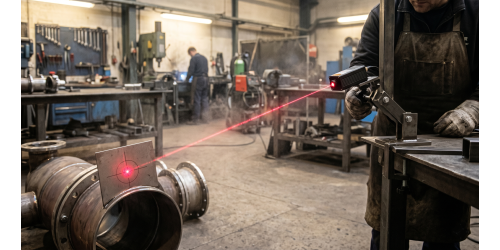
Lab calibrations pass, but thermal gradients and in-flight vibrations cause optical axis drift (>0.05 mrad budget), causing laser pulses to miss the target. Structural redesigns delay shipment by ~2.5 months, causing customer churn and price concessions.
Mode 2: Over-Engineering Decreasing Mission Efficiency
Insisting on maximum range without calculating weight penalties narrows coverage area per flight. Sunk development costs and re-validation wipe out initial module cost savings.
Mode 3: Interface & Protocol Over-Engineering
Opting for overly complex Ethernet (RJ45) instead of standard TTL or RS485 interfaces leads to gimbal protocol incompatibilities and software integration delays.
III. Two Physical Realities Impacting Product Commitments
1. Atmospheric Conditions & Target Reflectivity
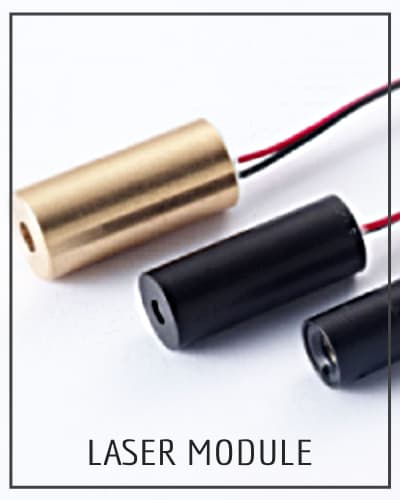
905 nm is lightweight and cost-effective for short-to-medium clear weather tasks; it degrades rapidly in fog or haze. 1535 nm Erbium-glass laser delivers superior atmospheric transmission for 4 km+ ranges and operates under Class 1 Eye-Safe standards with higher peak pulse energies. Failing to factor in atmospheric attenuation leads to severe customer SLA disputes.
2. Vibration, Thermal Gradients, and Software Limits
Algorithm compensation cannot replace mechanical stiffness. Thermal dissipation from laser drivers degrades sensor signal-to-noise ratios (SNR). Treating thermal management as an afterthought is a deferred project risk.
IV. Thermal Management: The Overlooked SWaP-C Variable
Heat impacts the system via three paths: micro-deformation inducing boresight drift, increased detector noise, and parasitic weight from added heatsinks. Conductive thermal pathways must be established early in gimbal design.
V. SWaP-C Selection Matrix & Recommended LRF Modules
Lock down critical mission constraints (range, environment, weight, power, timeline) before seeking the optimal SWaP-C configuration:
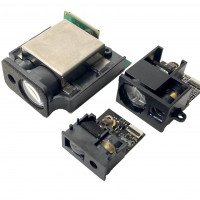
| Dimension | Short/Mid-Range (~1.5–2 km) LRFX00M3LSQ | Mid-Range (~3 km) LRF3K10LHQ | Long-Range (~4 km) LRF4K10LH |
| Wavelength / Safety | 905 nm (Class 1) | 1535 nm (Class 1 Eye-Safe) | 1535 nm (Class 1 Eye-Safe) |
| SWaP Profile | Ultra-Lightweight (<40g) | Compact Form Factor (<50g) | High Penetration Standard |
| Atmospheric Robustness | High in clear skies; drops in haze | Robust penetration in smoke/fog | Exceptional smoke & haze penetration |
| Payload & Thermal Impact | Requires careful gram-budgeting | Moderate & highly controllable | Requires larger gimbal structure |
| Best-Fit Application | Custom micro gimbals, altimetry | Mainstream tri-light EO/IR systems | Long-endurance UAVs, border patrol |
VI. Four Review Questions for Executive Management
Design Review Executive Checklist
- Mission Constraints vs. Spec Completeness: Are requirements derived from actual customer operational profiles or driven by spec-sheet competition?
- Vibration & Boresight Drift Budget: Has mounting stiffness been validated against platform vibration spectra? What is the drift tolerance (e.g., ≤0.05 mrad)?
- Interface Simplicity: Do protocols (TTL/RS485) match downstream hardware to avoid unnecessary software integration overhead?
- Comprehensive TCO Impact: Have field rework, customer battery cycle costs, and timeline slip risks been factored into the procurement decision?
Frequently Asked Questions (FAQ)
Why is 1535nm wavelength the standard for long-range drone EO/IR?
1535nm Erbium-glass laser is in the retina-safe spectrum. It allows higher pulse energy under Class 1 limits and delivers significantly superior atmospheric transmission through smoke and haze compared to 905nm.
Why can't boresight drift be solved solely via software algorithms?
Software filtering only corrects linear, predictable shifts. High-frequency in-flight vibrations and thermal shock cause non-linear mechanical deflections that overwhelm software corrections.
What engineering support does iADIY provide to drone integrators?
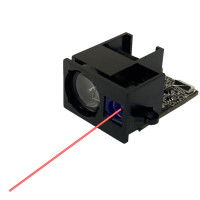
iADIY provides off-the-shelf LRF modules, SDK integration kits (UART/RS485), 3D CAD STEP models, optical alignment design reviews, and custom optomechanical packaging.
Conclusion: Moving from Component Buyer to System Partner
Long-range laser ranging is a vital capability for high-end UAV payloads, but project success is rarely defined by selecting the module with the largest theoretical range on a spec sheet. Success depends on achieving a predictable balance between weight, atmospheric transmission, optical axis stability, thermal control, and time-to-market.
Developing next-gen commercial drone EO/IR or tri-light gimbals? Discuss your SWaP budget and requirements with our engineering team.
Talk to our engineers about your application →Explore our complete lines of Laser Rangefinder Modules, Laser Sensors, and Optoelectronic Manufacturing Services.
Leave a Comment